
Website Planning for Rhode Island Businesses: What We Learned Rebuilding TNP Gutter Cleaning

Launching a website is a big step for any Rhode Island business, but it's not usually the launch that decides whether it works — it's what happens after. I recently rebuilt the site for TNP Gutter Cleaning, a Coventry-based company run by Tyler Patrick, and the difference between "before" and "after" says more about good planning than any generic checklist could.

What Tyler's Site Actually Looked Like
TNP's site wasn't broken, exactly. It had pages, it had photos, it technically worked. But it had the kind of problems that pile up when a site gets built once and then patched over time instead of planned properly:
All three service pages had been created by duplicating other pages — so they were still sitting on Wix's default URLs like /copy-of-home and /copy-of-gutter-repair
Every page shared the exact same title tag, meta description, and focus keyword
The site only ever said "Rhode Island" — never the actual towns Tyler serves
There was no structured data (schema) anywhere, so Google and AI tools had no clean way to understand what the business actually does
The AI-crawler file (llms.txt) only listed the homepage
None of this is unusual. It's what happens to almost every small business site over a few years of quick edits and "just duplicate that page for now."
Planning Around the Real Business, Not Generic Copy
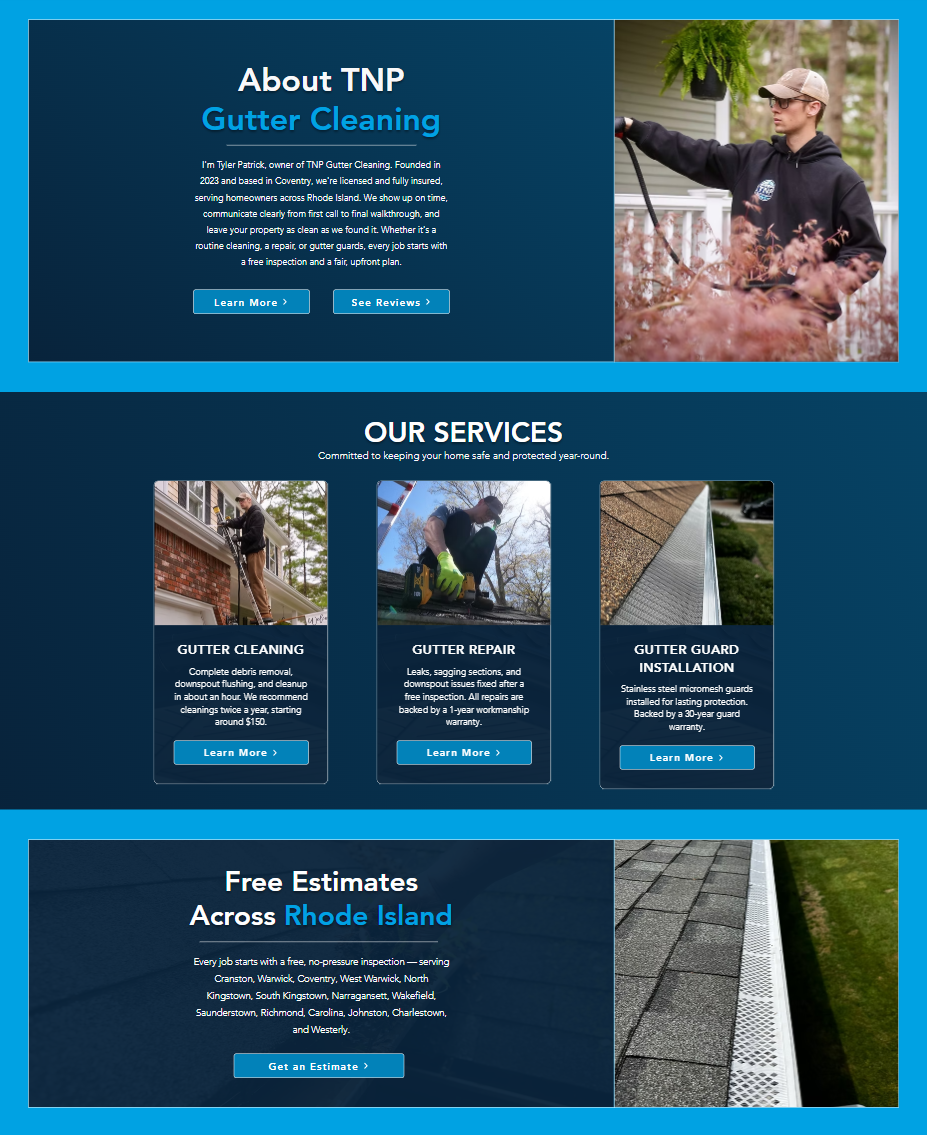
The fix wasn't a redesign for its own sake — it was rebuilding the site around how Tyler actually runs his business. Three real service pages went up: Gutter Cleaning, Gutter Repair, and Gutter Guard Installation, each walking through his actual process instead of templated marketing language.
The Gutter Guard page includes something most companies would never put on their own website: Tyler is upfront that gutter guards aren't a good fit for homes with heavy pine coverage — even though that's a sale he's turning away. That kind of honesty is exactly the kind of detail that makes a site trustworthy to a reader, and it's also exactly the kind of specific, factual content that search engines and AI tools can actually use. Generic "we're the best in the business" copy gives them nothing to work with. A true, specific answer does.
We also rewrote the homepage, About, and Contact pages around Tyler's real story — founded in 2023, based in Coventry, owner-operated, previously working full-time before going all-in on the business. And we built a 21-question FAQ, organized by category, phrased the way an actual homeowner would ask — which matters because that's precisely the format AI Overviews and "People Also Ask" results pull from.
Fixing the Fundamentals
A lot of the work was less glamorous but just as important:
Every page got its own unique title, meta description, and focus keyword, so Google could finally tell the pages apart instead of seeing seven pages competing for the same result
The duplicate-page URLs got cleaned up into real, readable ones
Alt text was written for every image on every page
Heading structure (H1s, H2s, H3s) was checked sitewide to make sure it was actually set correctly in Wix, not just styled to look right
The site's service area went from a single vague "Rhode Island" mention to a full, specific list — Cranston, Warwick, Coventry, West Warwick, North Kingstown, South Kingstown, Narragansett, Wakefield, Saunderstown, Richmond, Carolina, Johnston, Charlestown, and Westerly
That last one matters more than it sounds like it should. If a site only ever says "Rhode Island," it has no real reason to show up when someone searches or asks an AI tool about a specific town. Naming the towns you actually serve gives search engines and AI tools an actual reason to mention you.
The Part Most Website Planning Advice Skips: GEO
Most advice about website planning stops at SEO — ranking in Google. What it usually misses is GEO: how visible your site is to AI answer tools like ChatGPT and Google AI Overviews, which increasingly answer questions before a user ever clicks a search result.
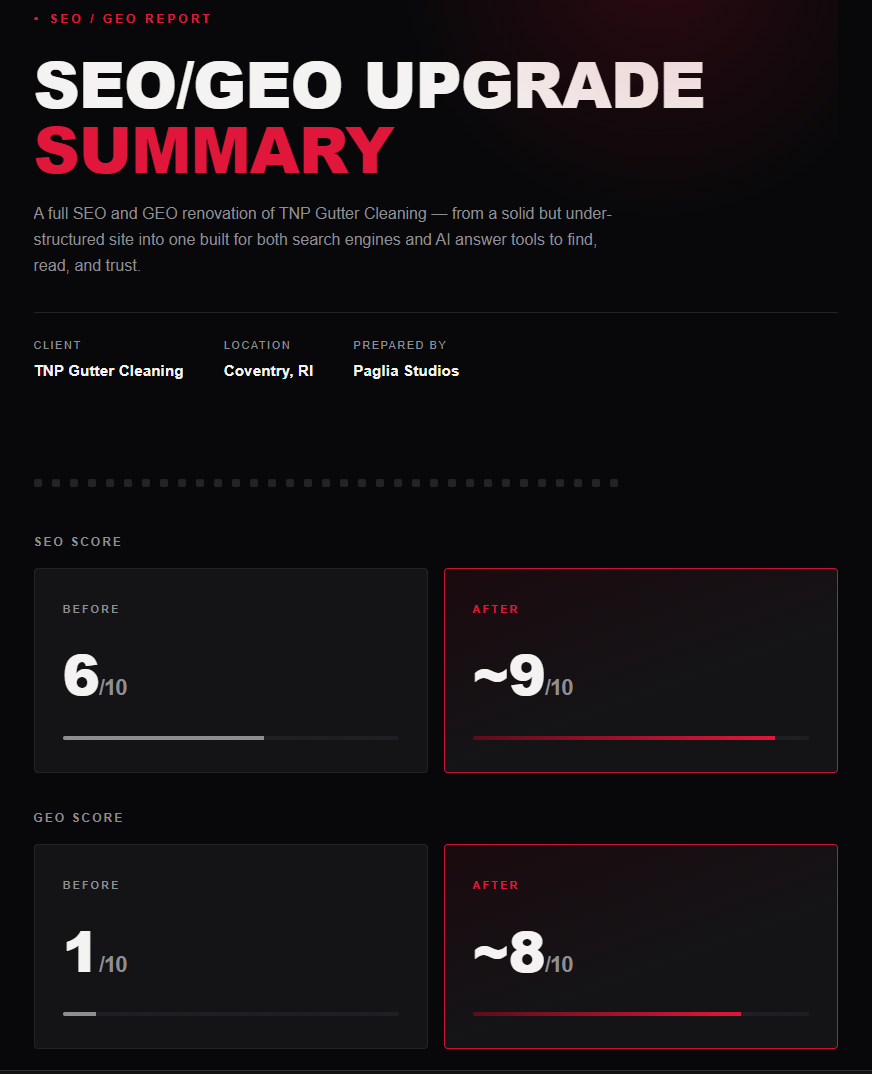
TNP's site went from a 1/10 to roughly an 8/10 on GEO, mainly through work most business owners have never heard of:
Schema markup added to every page — LocalBusiness data on the homepage, a Person schema tied to Tyler on the About page, Service schema with pricing on each service page, and FAQPage schema covering all 21 questions
The llms.txt file rebuilt to list all seven live pages instead of just the homepage
Confirming NLWeb (Wix's built-in AI-agent search protocol) was actually switched on
A full robots.txt and sitemap check to make sure nothing was quietly blocking legitimate crawlers
This is the difference between an AI tool guessing what a business does from a paragraph of marketing copy, and being handed a clean, structured answer it can actually use.
None of this guarantees a specific number of new customers overnight — nobody can honestly promise that, and Google and AI tools still need time to crawl, index, and build trust around what's new. But the site is now genuinely built for both search engines and AI tools, instead of just one of them.
What Website Planning for Rhode Island Businesses Requires
If you're planning a website for your Rhode Island business, the lesson from TNP isn't "hire someone to add schema markup" — it's that a website plan needs to account for more than launch day. Before you start:
Get specific about what makes your business different, the way Tyler's honest pine-tree answer does — generic copy doesn't help you with customers or with search
Name the actual towns or neighborhoods you serve, not just your state
Ask whoever builds your site whether they're planning for AI search tools at all, not just Google — most builders still aren't
Building a site is the easy part. Planning it around your real business, and keeping it maintained instead of duplicating pages and forgetting about them, is what actually makes it work. Reach out to me for a free aduit on your website!



Comments